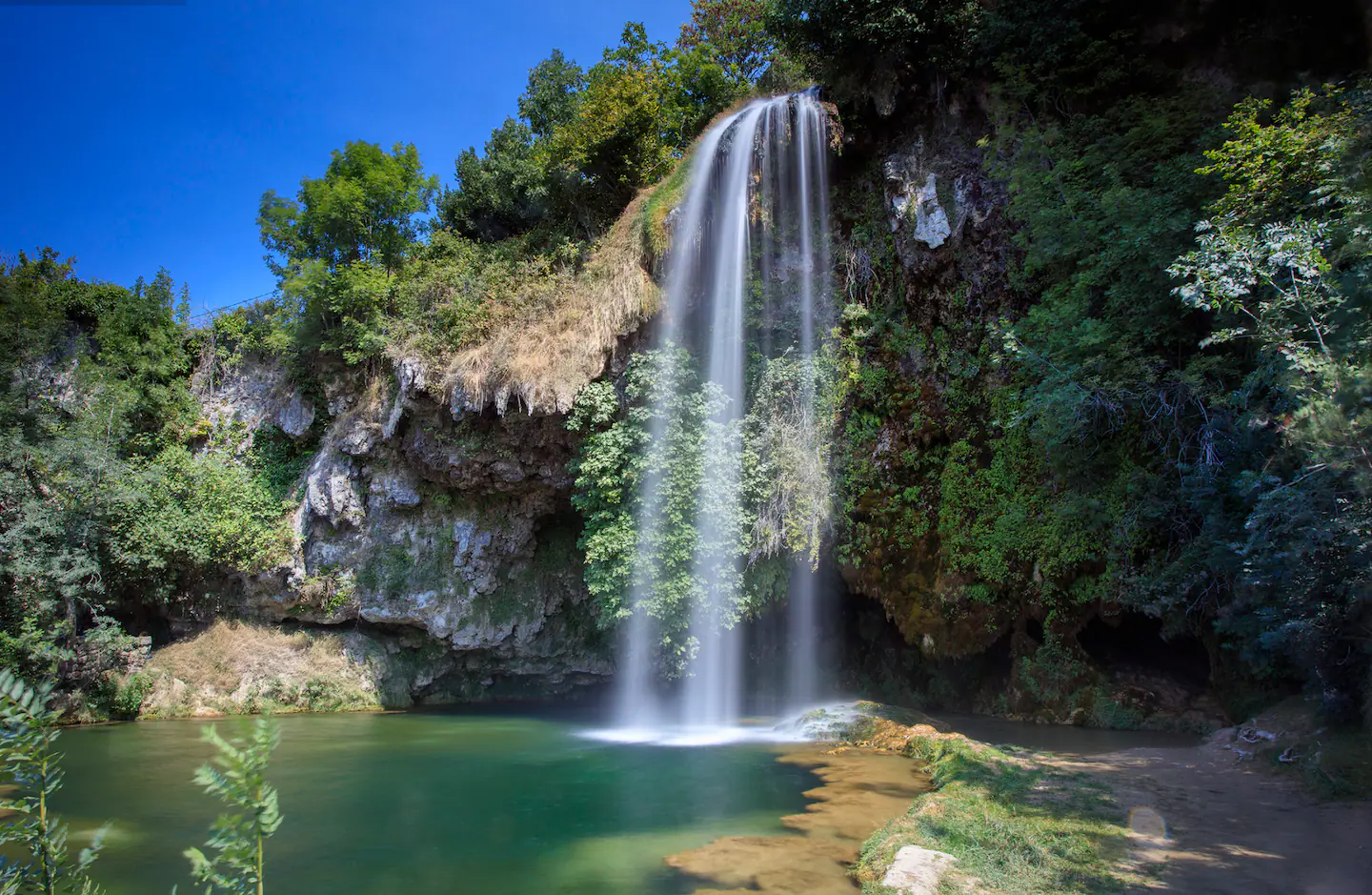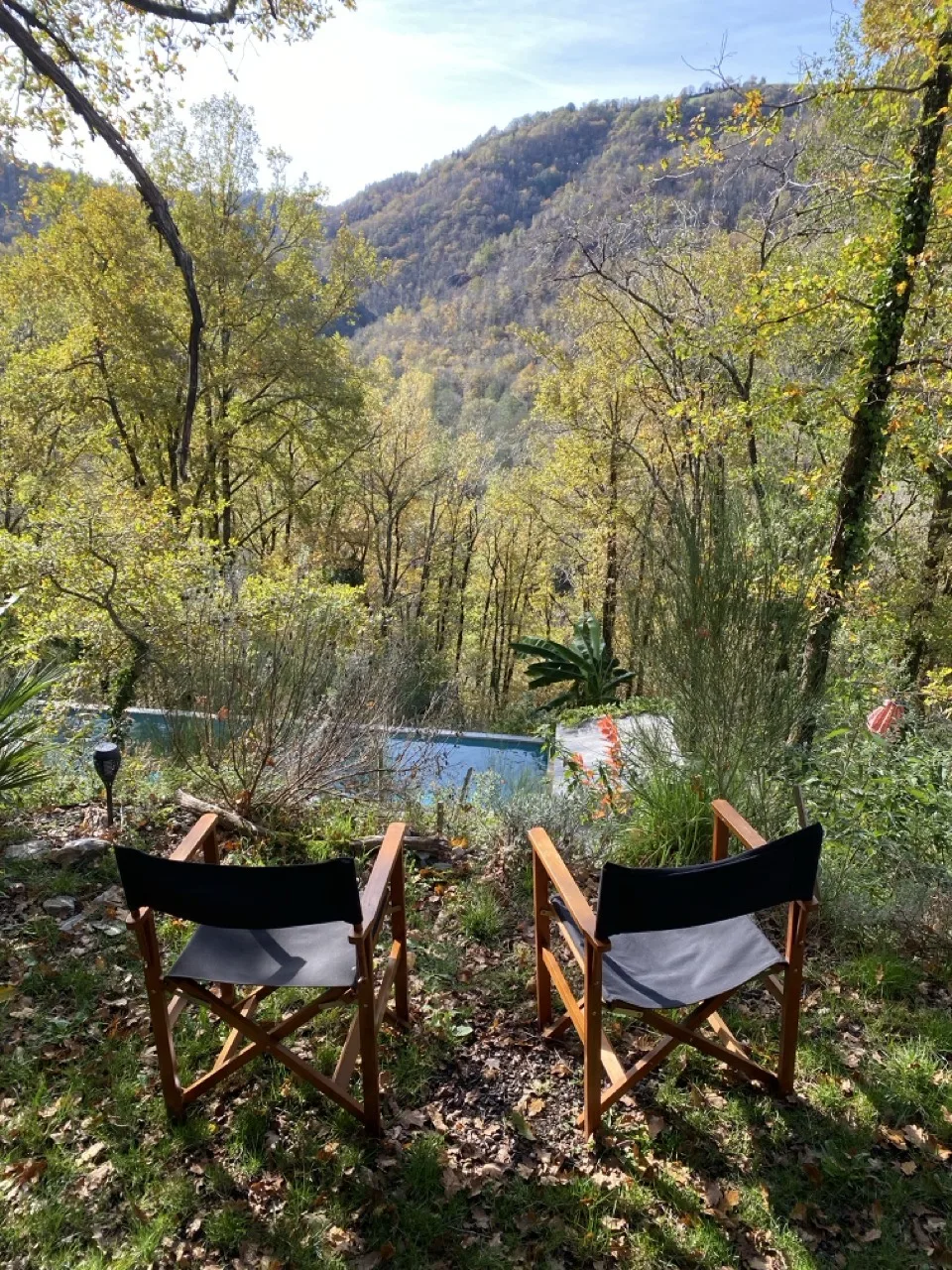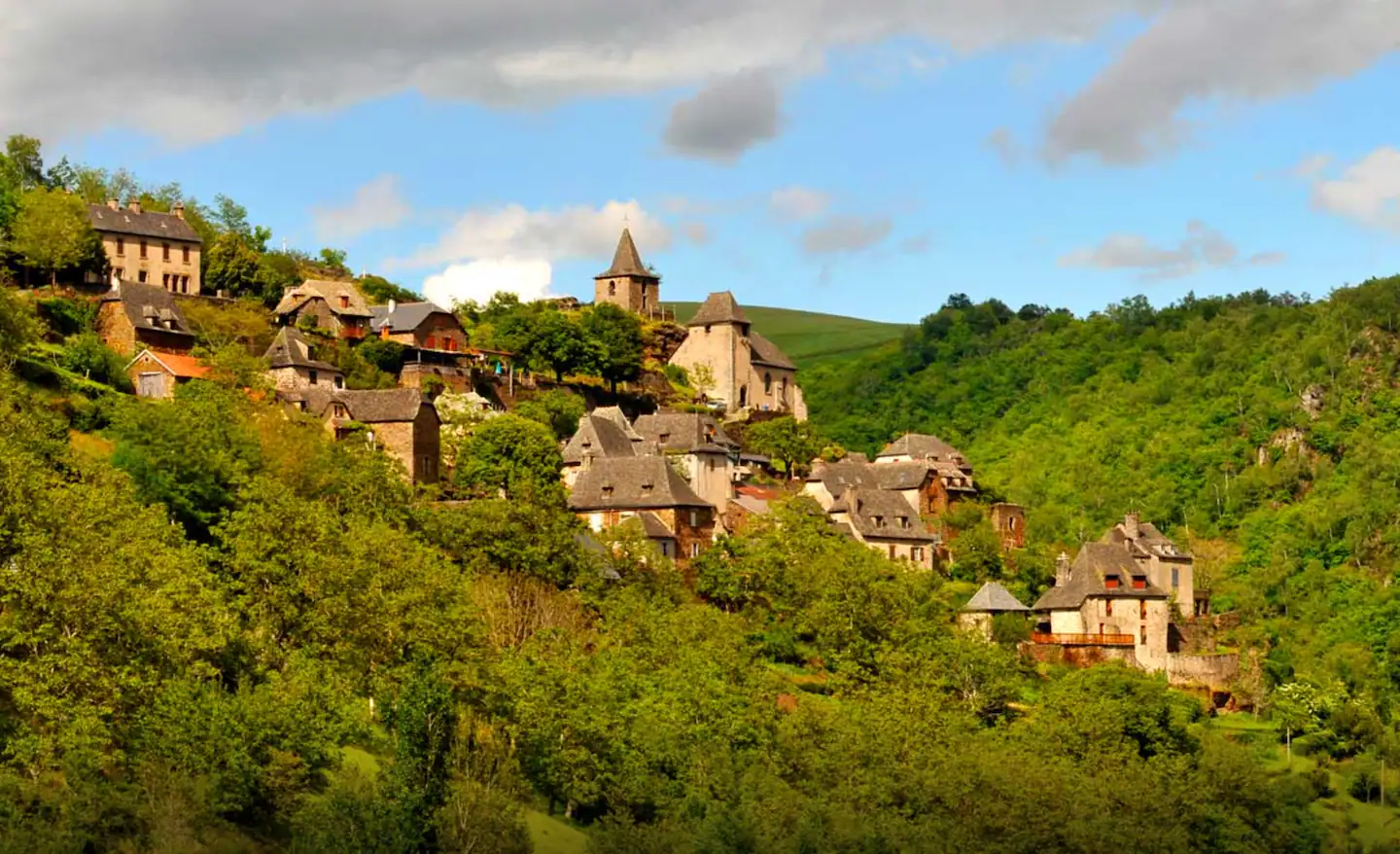
South Aveyron is one of the most singular territories in the Massif Central. At the meeting point of the Larzac plateau, the limestone causses, the Rougier de Camarès and the valleys of the Sorgues and the Tarn, this region offers contrasting landscapes and a heritage of exceptional richness. Partly inscribed on the UNESCO World Heritage List for its agro-pastoral landscapes (Causses and Cévennes), South Aveyron combines cave villages, Cistercian abbeys, medieval bastides and still very much living traditions.
From eco-lodge Lalalandes at Conques, allow around 1h30 to 2 hours by road to reach the most iconic sites of South Aveyron — ideal for a day trip.
1. Roquefort-sur-Soulzon: a village shaped by geology
World-famous for its AOP cheese, Roquefort-sur-Soulzon owes its very existence to a unique geological phenomenon: the collapse of the Combalou, which occurred several million years ago. This subsidence created a network of natural fissures called fleurines, which provide constant ventilation of the caves at a stable temperature and humidity — ideal conditions for cheese ageing.
Written records attest to production at Roquefort since the 11th century. In 1411, King Charles VI granted the inhabitants an official monopoly on ageing — one of the first signs of regional product protection in France.
Not to be missed: the Combalou belvedere, accessible via a waymarked path, offers a complete geological reading of the site and a plunging view over the Soulzon valley.
2. Saint-Affrique: historic crossroads of the South Rouergue
Situated at the confluence of the Sorgues and the Dourdou de Camarès, Saint-Affrique developed as a commercial and administrative centre of the South Rouergue. Its medieval Pont Vieux, old houses and weekly producers' market make it a pleasant stop.
- Medieval Pont Vieux — sober and solid architecture, typical of the Rouergue
- Producers' market — cheeses, charcuterie, local vegetables
- Walks along the Sorgues — peaceful valley-bottom trails
3. The Rougier de Camarès: red soils unique in France
The Rougier de Camarès is a remarkable geological formation made up of Permian sedimentary deposits, dating back around 250 to 300 million years. The intense red colour comes from the oxidation of iron in the sediments — a phenomenon documented in regional geological surveys.
The contrasts between red soils, dark rocks and green vegetation make this territory particularly photogenic. The villages of Camarès, Montlaur and Mélagues integrate into this singular landscape like nowhere else in France.
Hike: the Rougier trail, starting from Camarès, allows observation of all the geological formations over several kilometres, in great solitude.
4. Peyre: cave village on the Tarn cliffs
Listed among the Most Beautiful Villages of France, Peyre is partly carved into the limestone cliff that dominates the Tarn. Its semi-troglodytic houses, the church of Saint-Christophe partly hewn from the rock and its medieval caves bear witness to an ancestral way of life. Implantation in the cliff provided better thermal regulation and natural protection against flooding from the Tarn.
5. Sylvanès abbey: Cistercian architecture and sacred music
Founded in the 12th century, Sylvanès abbey is one of the purest examples of Cistercian architecture in Aveyron — stripped back, luminous, harmonious proportions. Abandoned after the French Revolution, it was restored in the 20th century and transformed into a Cultural Meeting Centre.
Sylvanès was one of the first places in France to host gatherings of sacred music from different cultures, contributing to an international reputation. The forest trails around the abbey offer walks of absolute calm.
6. The southern Larzac: open landscapes and pastoral heritage
The southern part of the Larzac is characterised by open expanses, dry pastures and scattered settlements. Jasses (sheepfolds), lavognes and transhumance drailles form a heritage protected under the UNESCO Causses and Cévennes designation. These drailles often follow medieval, even ancient, routes — you walk literally in the footsteps of shepherds from another century.
7. Outdoor activities in South Aveyron
- Hiking on the GR 71C between valleys and causses
- Circuits around the Sorgues valley
- Rock climbing on the limestone cliffs of the Tarn
- River swimming in authorised zones
- Wildlife and flora observation on the causses — orchids, griffon vultures, junipers
These routes often offer great solitude even in high season — Aveyron keeps its secrets for those who take the time to venture in.
Little-known places to discover
- Cirque de Marnhagues-et-Latour — little visited, grand setting
- The source of the Sorgues — a major karstic phenomenon
- The Larzac corniche — sweeping views over the Rougier and the valleys
Want to explore South Aveyron from an ideal base? Eco-lodge Lalalandes at Conques is 1h30 from the main sites. Pierre knows the region and can advise on the best routes and addresses.
Book your stayPractical information
- Distance from Lalalandes: Roquefort 1h30 · Peyre 1h15 · Sylvanès 1h
- Best period: spring and autumn for hiking — summer for river swimming
- Tip: combine two or three sites in a day by setting off early — Aveyron roads are winding but magnificent